UCP Is On by Default: Is Your Shopify Catalogue Ready for AI Agents?
Summer '26 turned on the Universal Commerce Protocol for every Shopify store and added an Agentic section to the admin. Your products are already exposed to AI shopping agents. Here is how to audit what they actually see.
7 min read
The most consequential thing in Summer '26 Editions was not the one with a countdown attached. It was a default. The Universal Commerce Protocol is now enabled on every Shopify store, and there is an Agentic section in every admin. Your products are discoverable to AI shopping agents whether or not anyone on your team decided that.
That removes the question of whether to participate. What remains is a quality question, and it is not a marketing one. Agents read structured product data, and most catalogues were never built to be read by anything other than a human scrolling a product page.
What changed, precisely
Three things landed together and are worth separating.
UCP enabled by default. The protocol, announced by Google and Shopify in January 2026, defines how AI agents read a merchant catalogue and construct a cart. Previously it required setup. Now it does not, and Shopify removed the approval requirement for UCP-based agents in June.
An Agentic section in the admin. One place to see which AI channels have access to your catalogue and how your products are represented to them.
A separate protocol landscape outside Shopify. UCP is not the only standard. OpenAI's Agentic Commerce Protocol, co-developed with Stripe, sits in front of ChatGPT. Google's AP2, Visa's Trusted Agent Protocol and Mastercard's Agent Pay handle the payments layer. Merchants supporting more than one protocol see meaningfully more agentic traffic than merchants supporting one.
📌
Worth remembering: OpenAI deprecated Instant Checkout in March 2026, shifting the model from buying inside the chat to discovering inside the chat and transacting on the merchant site. That is good news for merchants. You keep the customer relationship, the login and the loyalty data. It also means your product detail page still matters, because that is where the agent sends the buyer.
What an agent sees that a shopper does not
A human on a product page fills gaps by inference. They see a photo and know the shoe is black. They read a paragraph of brand copy and conclude it is waterproof. An agent evaluating a query like a waterproof trail runner under 150 euros with a wide toe box does none of that. It matches structured attributes, and an attribute that only exists in prose or in an image does not exist.
This is where most catalogues fail. The common patterns:
| Gap | What it looks like | Consequence for the agent |
|---|---|---|
| Attributes trapped in description prose | Material, fit, waterproof rating written in a paragraph | Product filtered out of attribute-constrained queries |
| Inconsistent option naming | Colour values as Black, black, Jet Black, BLK across the catalogue | Variant matching fails, product looks like several products |
| Missing or vague GTINs | Blank barcode fields, or placeholder values | Product cannot be reconciled across sources, trust drops |
| Availability that lies | Stock levels that lag real fulfilment by hours | Agent recommends items it cannot buy, which suppresses future surfacing |
| No structured dimension or weight | Shipping-relevant data only in a PDF or a table image | Agent cannot evaluate delivery constraints |
None of these are exotic. They are the ordinary result of a catalogue built over five years by several people with no shared schema.
The audit, in one afternoon
- Open the Agentic section and read it as a report card. It tells you which channels have access and how products surface. Start there rather than with a theory.
- Pick your ten highest revenue products and write out their buying criteria. Not your marketing copy. The four or five things a customer actually filters on. Size, material, compatibility, capacity, whatever applies.
- For each criterion, find where it lives in the data. If the answer is the description field or the third product image, that is a gap. Structured fields only.
- Audit option value consistency across the catalogue. Export product options and count distinct values per option name. Any colour option with more than about thirty distinct values in a normal catalogue is a naming problem, not a range problem.
- Check identifier coverage. Count variants with a populated, valid barcode. Below ninety percent, fix that before anything else.
- Verify your JSON-LD still matches. Structured data on the page and catalogue data in the protocol should not disagree. Where they do, agents and search engines both discount you.
A quick way to get the coverage numbers without waiting on a BI build:
// Coverage audit: how much of your catalogue is machine-readable?
const query = `
  query ProductAudit($cursor: String) {
    products(first: 100, after: $cursor) {
      pageInfo { hasNextPage endCursor }
      edges {
        node {
          id
          title
          productType
          options { name values }
          variants(first: 100) {
            edges {
              node { sku barcode weight availableForSale }
            }
          }
          metafields(first: 25) { edges { node { namespace key } } }
        }
      }
    }
  }
`;

function summarise(products) {
  let variants = 0;
  let withBarcode = 0;
  let withWeight = 0;
  const optionValues = new Map();

  for (const product of products) {
    for (const option of product.options) {
      const seen = optionValues.get(option.name) || new Set();
      option.values.forEach((v) => seen.add(v.trim().toLowerCase()));
      optionValues.set(option.name, seen);
    }

    for (const edge of product.variants.edges) {
      variants += 1;
      if (edge.node.barcode) withBarcode += 1;
      if (edge.node.weight > 0) withWeight += 1;
    }
  }

  return {
    variants,
    barcodeCoverage: withBarcode / variants,
    weightCoverage: withWeight / variants,
    distinctOptionValues: Object.fromEntries(
      [...optionValues].map(([name, set]) => [name, set.size])
    )
  };
}
Barcode coverage below ninety percent, weight coverage below eighty percent, or an option with a wildly high distinct value count are all things you can fix this quarter with merchandising time rather than engineering time.
Where metaobjects earn their keep
Once you know which attributes matter, the question is where to put them. Cramming everything into product tags is the fast wrong answer, because tags have no type, no validation and no shared vocabulary.
Metafields with a defined type give you validation. Metaobjects give you a shared vocabulary, so a material is a referenced entity rather than a string retyped on four hundred products. That distinction is what makes attribute data stay clean over time instead of degrading the moment a new merchandiser joins. We covered the modelling patterns in our metaobjects and metafields guide.
The same structured data feeds your JSON-LD, which still matters for both traditional search and AI answers. Our schema markup guide for AI agents covers the markup side, and our ChatGPT discoverability audit covers how to check what assistants currently say about your brand.
What this is worth
AI referral traffic to retail sites grew sharply through early 2026, and referred visitors have tended to convert better than average because they arrive with intent already formed. The absolute volume is still small for most merchants. The reason to act now is not the current channel size, it is that catalogue data quality has a long lead time. You cannot fix four hundred product records in the week an agent starts sending traffic.
🔎
We run agentic readiness audits covering catalogue structure, identifier coverage, protocol exposure and structured data consistency, delivered as a prioritised fix list. See our technical SEO audit service.
Frequently asked questions
Can I turn UCP off?
You can manage AI channel access from the Agentic section in the admin. Turning it off is rarely the right call, since it removes visibility without solving any underlying data problem.
Do I need to support ACP as well as UCP?
If ChatGPT and Copilot matter to your category, yes. Merchants exposed to more than one protocol consistently see more agentic traffic. Start with catalogue quality, since both protocols read the same underlying data.
Will AI agents cannibalise my organic search traffic?
They shift where discovery happens, not whether it happens. Since checkout returns to the merchant site under the current model, the practical effect is a change in referral mix rather than a loss of the transaction.
How do I measure traffic from AI agents?
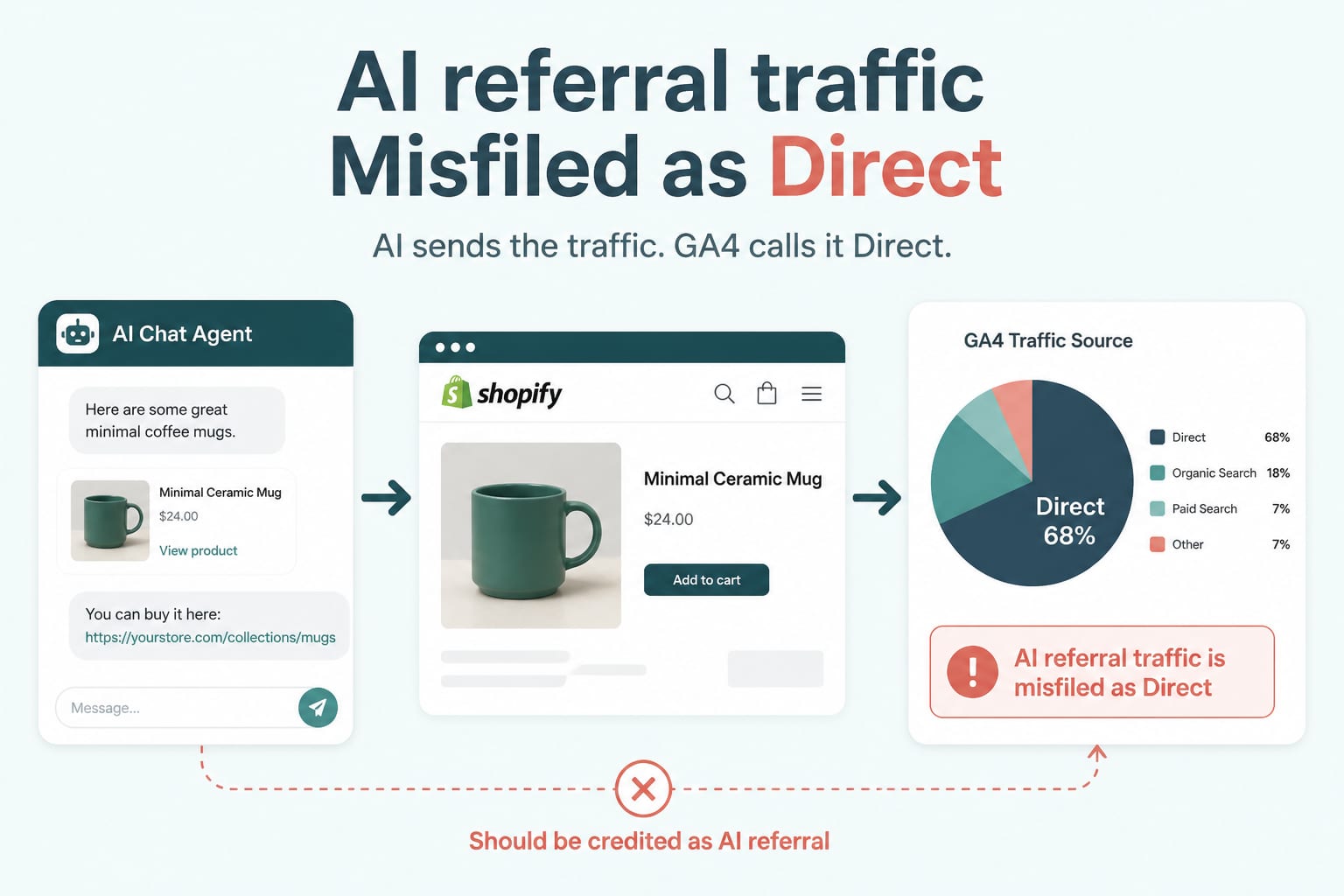
Poorly, with default analytics. AI referrals are frequently misattributed as direct traffic. This deserves its own treatment and we will cover it separately.
Is this only relevant for large catalogues?
No. Small catalogues are often easier to fix and see the benefit faster, because the entire attribute model can be corrected in days rather than quarters.
Related Topics
Related posts
View all articles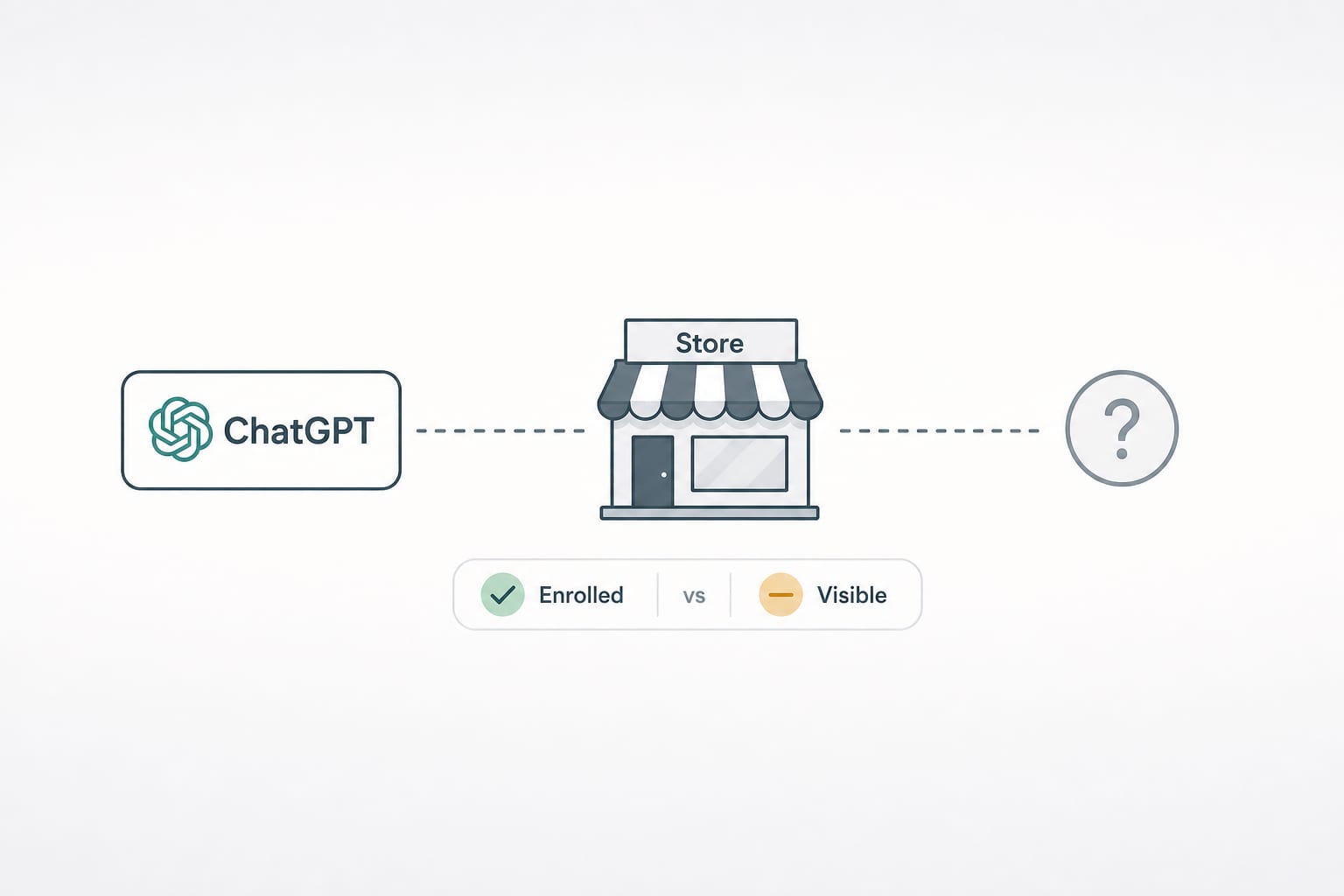
Technical SEOApr 7, 2026
Is Your Shopify Store Discoverable Inside ChatGPT? A 10-Minute Audit for Agentic Storefronts
On March 24, 2026, Shopify made 5.6 million stores discoverable to AI agents by default. Here is the 10-minute audit we run to tell whether your store is actually getting recommended, or just enrolled.
13 min read
Technical SEOApr 14, 2026
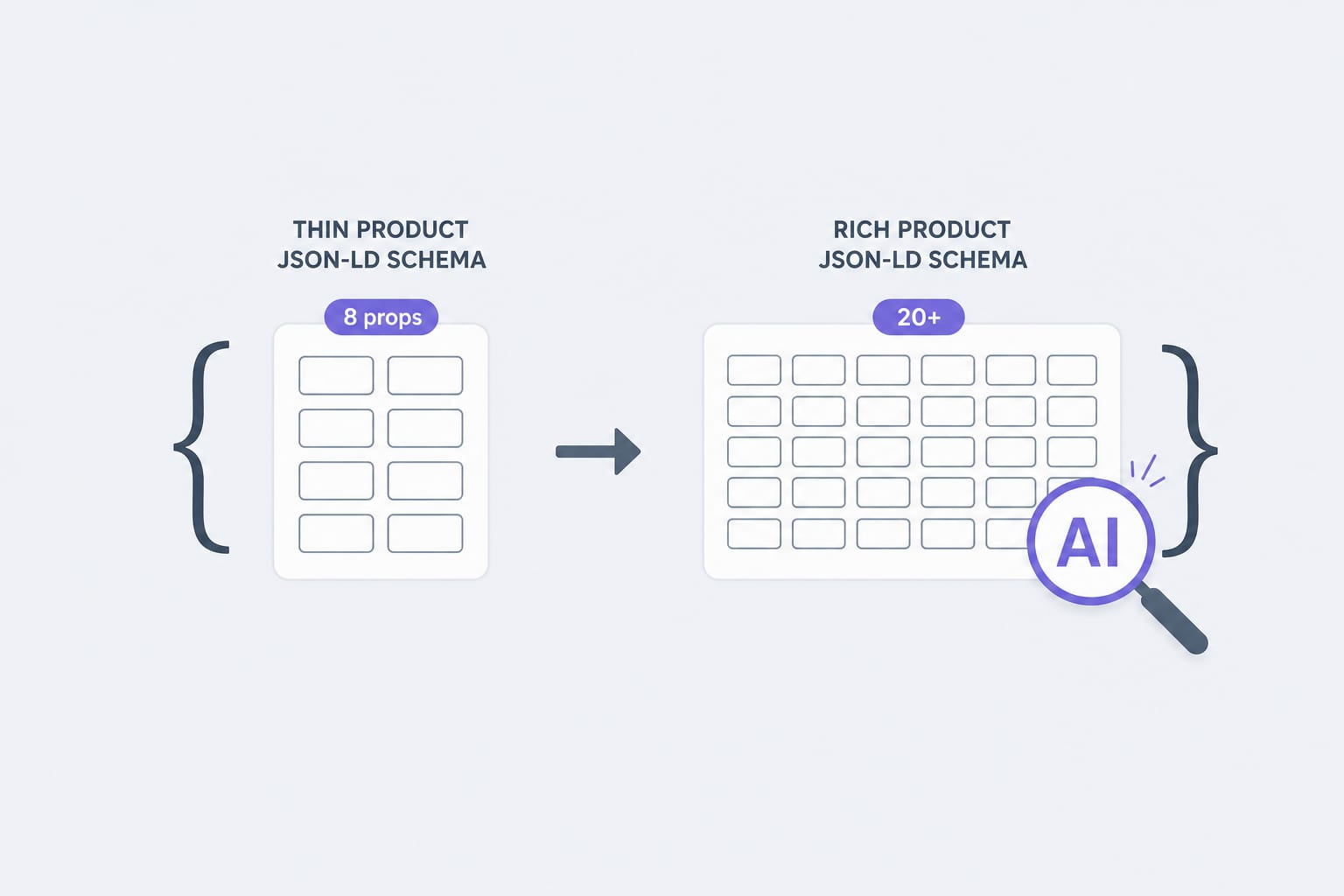
Schema Markup for Shopify in 2026: The JSON-LD Properties AI Agents Actually Read
Traditional Product schema uses 8 to 12 properties. AI agents lean on 20 or more. Here is the property list, the validation rules, and the implementation pattern we use for Shopify stores in 2026.
12 min read
Data AnalyticsAug 18, 2026
Your AI Referral Traffic Is Being Misattributed: Fixing GA4 for Agent-Sent Buyers
AI referrals grew sharply through 2026 and convert above average, but most stores cannot see them because default analytics files them as direct. Here is how to build a channel group that actually reports them.
6 min read