Is Your Shopify Store Discoverable Inside ChatGPT? A 10-Minute Audit for Agentic Storefronts
On March 24, 2026, Shopify made 5.6 million stores discoverable to AI agents by default. Here is the 10-minute audit we run to tell whether your store is actually getting recommended, or just enrolled.
13 min read
On March 24, 2026, Shopify flipped a switch and 5.6 million stores became discoverable inside ChatGPT, Microsoft Copilot, Google AI Mode, and the Gemini app. No app to install, no integration to configure. Just a default toggle in the Sales Channels admin labelled "Agentic Storefronts."
The marketing version of this story is simple: your store is now AI-ready. The operational version is more honest: your store is now eligible to be recommended by an AI agent, but whether it actually gets recommended depends on whether your product data is clean enough for a language model to choose it confidently from a list of competitors.
Enrollment is the floor. Visibility is the game. And the gap between the two is where most of the merchants we talked to in the past three weeks are sitting without knowing it.
This post is the 10-minute audit we run with a client before quoting any work. It will not turn your store into the top result in ChatGPT. It will tell you, in plain terms, whether you are invisible, partially visible, or actually getting picked.
What changed on March 24, 2026
Three things shipped almost simultaneously and they fit together as one stack.
The Shopify Catalog is the unified product feed that Shopify maintains for every eligible merchant. It contains your products, variants, prices, inventory signals, and structured attributes. Before March, this feed powered Shop App and a few partner integrations. After March 24, it became the source of truth that AI agents query when a shopper asks "find me a wool overcoat under 400 euros that ships to France."
The Storefront MCP server lives at /api/mcp on every Shopify store. MCP stands for Model Context Protocol, an open standard that lets language models query external systems in a structured way. The endpoint exposes your product catalog, policies, and selected metafields to any compliant AI agent. It is on by default for most plans.
The Universal Commerce Protocol (UCP), co-developed by Shopify and Google and announced at NRF in January 2026, is the wire format AI agents use to query products and complete checkouts across merchants. ChatGPT, Microsoft Copilot, Perplexity, and Google AI Mode all speak UCP, which means a single clean Shopify data layer reaches all of them at once.
The practical effect is that the funnel has a new front door. The old one is Google. The new one is a conversation in ChatGPT where the agent picks three products from a list of fifty thousand candidates and presents them to the buyer as recommendations. If your products are not in that list of three, the buyer never sees you.
📡
For US merchants whose products are in the Shopify Catalog, ChatGPT shoppers can already find them. International rollout is in progress, with Microsoft Copilot live in several markets and Google AI Mode rolling out via UCP. If you are an EU merchant, your products are syndicated to ChatGPT discovery today, with native checkout in the chat surface following on a per-channel basis.
Why traditional SEO is not enough here
Most agencies are responding to this shift by saying "do better SEO." That is not wrong, but it is incomplete in a way that matters.
Traditional SEO ranks pages. Google sends a human to your URL, your page renders, your CTAs fire, your conversion path runs. Agentic discovery ranks products. The agent never loads your CSS or your hero image. It reads structured data, evaluates whether your product matches the shopper's intent, and either includes you in the recommendation list or filters you out before the buyer sees anything.
Two practical consequences follow.
The first is that the success measure shifts from "ranking on a SERP" to "being recommended in a conversation." There is no position 1, no featured snippet, no SERP. The agent makes a choice. You are in or you are out.
The second is that the optimization surface moves from page-level metadata (titles, meta descriptions, H1) to product-level structured data (titles, descriptions, attributes, metafields, schema). A store with beautiful pages and thin product data will rank well on Google and disappear in ChatGPT. We are already seeing this with clients who have excellent Core Web Vitals scores and zero AI agent inclusions.
If you have not read our audit checklist for Core Web Vitals, do it after this one. The two audits are complementary: CWV decides whether a buyer who clicks through actually converts, and the data audit below decides whether the buyer is ever sent in the first place.
The 10-minute audit, in order
Run these checks in sequence. Each one takes 30 seconds to 2 minutes. At the end you will have a clean picture of whether your store is set up to be recommended or whether you are still in the "enrolled but invisible" bucket.
Step 1: Confirm Agentic Storefronts is enabled (30 seconds)
Open your Shopify admin. Navigate to Settings → Sales channels → Agentic Storefronts. You should see toggles for ChatGPT, Microsoft Copilot, Google AI Mode, and the Gemini app.
If the toggles do not appear, your store is not eligible yet. The most common reasons are: you are not on a supported plan, your business address is in a market that has not rolled out yet, or your store has a Shopify Catalog block (often caused by missing tax or shipping configuration).
If the toggles are visible and switched on, move to step 2. Being enrolled means agents can see you. It does not mean they will pick you.
Step 2: Hit your MCP endpoint yourself (1 minute)
Every Shopify store has a live MCP endpoint. You can query it without authentication for product discovery. Run this from a terminal:
// Replace YOUR-STORE.myshopify.com with your storefront domain
fetch('https://YOUR-STORE.myshopify.com/api/mcp', {
  method: 'POST',
  headers: { 'Content-Type': 'application/json' },
  body: JSON.stringify({
    jsonrpc: '2.0',
    method: 'tools/list',
    id: 1
  })
}).then(r => r.json()).then(console.log);
You should see a list of tools, including search_shop_catalog, get_product_details, and get_shop_policies. If you get a 404 or an HTML error page, your MCP endpoint is not exposed. Open a support ticket with Shopify before going further.
If you got tools back, swap the method to tools/call and call search_shop_catalog with one of your own product queries. The response is the literal text an AI agent receives when a shopper asks about products like yours. Read it carefully. This is the surface area you are optimizing.
Step 3: Check what an agent sees for a real query (2 minutes)
Open ChatGPT (any plan, signed in) and run a query that should obviously surface your store. If you sell organic cotton t-shirts in France, ask: "Find me organic cotton t-shirts that ship to France, under 50 euros, preferably from European brands."
Three outcomes are possible.
You appear in the recommended list. You are visible. Move to step 4 to check whether your listing is good or just present.
A competitor in your category appears but you do not. You are filtered out. Go straight to step 5; you have a data quality problem, not a visibility problem.
Nothing in your category appears. The query is either too narrow, or the agent does not yet have enough merchants in this geo for this category. Try three more queries before drawing conclusions.
Step 4: Inspect your own product as the agent sees it
Pick one of your bestsellers. Open the Shopify admin product detail page. Check, in order:
The product title. Is it the title a human would type in a search bar, with the right specificity? "Classic Tee" is invisible. "Organic Cotton Crew Neck T-Shirt - Heavyweight 240 GSM, Made in Portugal" is choosable.
The product description. Does it answer the questions a shopper asks before buying? Materials, fit, sizing guidance, care, country of origin, certifications. AI agents lean heavily on this text to write the explanation of why your product was recommended.
The product type and tags. These map to Google Product Category internally and influence which buckets of intent you compete in.
The variant data. Every variant should have a SKU, a price, real-time inventory, and explicit availability. Variants with missing or stale stock are systematically de-prioritized by agents because the worst experience for the AI is recommending an out-of-stock item.
The metafields. This is where most stores leak the recommendation. If your products do not have structured metafields for the attributes that matter in your category (material composition, weight, certifications, dimensions, recommended use cases), the agent has to guess from prose. It will not. It will pick the competitor whose data is structured.
Step 5: Audit your structured data and policies
Open your product page in a fresh browser tab. Right-click, view source, and search for application/ld+json. You should find at least a Product schema block with name, description, sku, image, offers, availability, and price. If you cannot find Product schema, that is your first fix.
The bar is higher than it used to be. Traditional SEO schema covers maybe 8 to 12 properties. AI agents lean on 20 or more contextual properties when scoring a product for recommendation, including material, color, size, manufacturer, countryOfOrigin, gtin, mpn, aggregateRating, and category-specific extensions. We published the full property list for AI-aware Product schema in our Schema Markup for Shopify in 2026.
Then check /policies/shipping-policy, /policies/refund-policy, and /policies/privacy-policy. Agents quote these directly when answering questions about returns, delivery, and data handling. If your policy pages are vague, autogenerated, or contradict each other, the agent will either skip you or describe you in language that makes the shopper bounce.
Step 6: Check attribution
In Shopify admin, Analytics → Reports, filter orders by referral source = ChatGPT (and Copilot, and the others). If you have been live for at least two weeks and have non-zero traffic, you should see some referrals. Zero referrals after two weeks usually means visibility issues rather than conversion issues, and you should re-run steps 3 to 5.
For attribution beyond what Shopify natively surfaces, you will want server-side tracking. We covered the setup in server side tracking for Shopify.
The five issues that make stores invisible
We have run this audit on roughly 40 stores since March 24. The same five issues come up nearly every time.
Thin product titles. Generic, brand-only, or fashion-style poetic titles. Agents need specificity to choose your product over a generic competitor.
Missing structured attributes. No material, no weight, no dimensions, no fit guidance, no origin, no certifications. Even when a product is excellent, the agent cannot tell.
Inconsistent or partial metafields. Metafields exist but only for half the catalog, or different products use different namespaces and keys. The agent gets a partial signal and discounts the product.
No Product schema or schema that lies. Schema present but missing availability, or with priceCurrency mismatched to the offered currency, or with stale aggregateRating. Better to omit than to publish wrong.
Out-of-date inventory feeds. Agents heavily penalize merchants who recommend out-of-stock items. If your inventory sync to the Catalog is slow or batched, you are losing recommendations even when you have stock.
- Agentic Storefronts toggle: ON in admin
- MCP endpoint at /api/mcp returns a tools list when queried
- Live ChatGPT query for your category surfaces your products
- Bestseller product has specific title, full description, real metafields
- Product page exposes JSON-LD Product schema with 15+ properties
- Policies pages are clear, current, and non-contradictory
- Shopify Analytics shows non-zero referrals from at least one AI channel
What this means for the next 12 months
The shift is real, but it is not yet a flood. AI-driven traffic still represents under 1% of total retail traffic for most stores, and a chunk of AI-attributed visits ultimately convert through branded Google searches, which means the AI contribution is invisible in last-click analytics.
Two things make us confident this is still the right thing to invest in now.
First, AI-attributed orders are up roughly 11x year over year on Shopify, and AOV on agent-driven orders runs about 30% higher than the baseline. The buyers who come through this channel are high-intent: they have already had a conversation with an AI about exactly what they need, and they are clicking through to buy, not to browse.
Second, the optimization work compounds. Every metafield you structure, every schema property you add, every policy page you tighten makes you more findable in ChatGPT, more findable in Google's traditional results, more findable in Copilot, and more findable in whatever AI surface ships next. The investment is not channel-specific.
We expect the international rollout to complete through Q3 and Q4 2026, the EU to get native checkout in at least one major AI surface before the end of the year, and AI-attributed traffic to cross the 5% threshold for stores that have done the data work. The merchants who structured their data in April will be the merchants whose products an agent picks in October.
⚠
If your store is on a custom or headless stack and your storefront lives outside Shopify's Catalog graph, none of the above is automatic. Headless storefronts on Hydrogen are first-class because they share the same data plane. Headless on Next.js or a custom stack requires deliberate work to syndicate product data into Shopify Catalog and to expose the right MCP surface. We covered the architectural tradeoff in Hydrogen vs Next.js.
FAQ
Is my Shopify store already discoverable in ChatGPT?
If you are a US merchant on a supported plan with products in the Shopify Catalog and the Agentic Storefronts toggle on, yes. If you are an EU or UK merchant, your products are syndicated to ChatGPT discovery today and native checkout is rolling out per channel. Run step 1 of the audit above to confirm.
Do I need to be on Shopify Plus?
No. The toolkit works on any Shopify plan. Shopify Plus stores get higher API rate limits, Partner-account governance options, and earlier access to some channels, but the core MCP and Catalog infrastructure is identical.
How do I see AI-referred traffic in analytics?
Shopify Analytics surfaces ChatGPT and other AI referrals as separate referral sources. For deeper attribution, including assisted conversions where the buyer came via ChatGPT but completed on a different visit, you need server-side tracking with proper UTM handling and a data warehouse for joins.
What happens with international stores?
International rollout is staged per channel. ChatGPT discovery is global for eligible products. Microsoft Copilot direct checkout is live in several markets including parts of the EU. Google AI Mode native checkout via UCP is rolling out to select brands. Toggling the channels on or off lives in admin under Sales Channels.
Will this kill traditional SEO?
No. Traditional SEO still matters for human shoppers using Google, which is the bulk of traffic for almost every store. Agentic discovery adds a parallel channel where AI agents recommend products inside chat interfaces. The skills overlap (clean structured data, clear copy, schema markup, authoritative content), but the channels are additive, not substitutive.
Where to go from here
If your audit turned up data quality issues, the next two posts in this series go deeper on the fixes. Schema markup for Shopify in 2026 covers the JSON-LD properties that AI agents actually read, with the full property list per category. Metaobjects and metafields covers the data architecture that lets you populate that schema cleanly across thousands of SKUs.
If you want us to run the audit on your store and write the remediation plan, get in touch. We do this in a two-hour technical workshop with your dev team, and you leave with a prioritized fix list mapped to your catalog.
Related posts
View all articles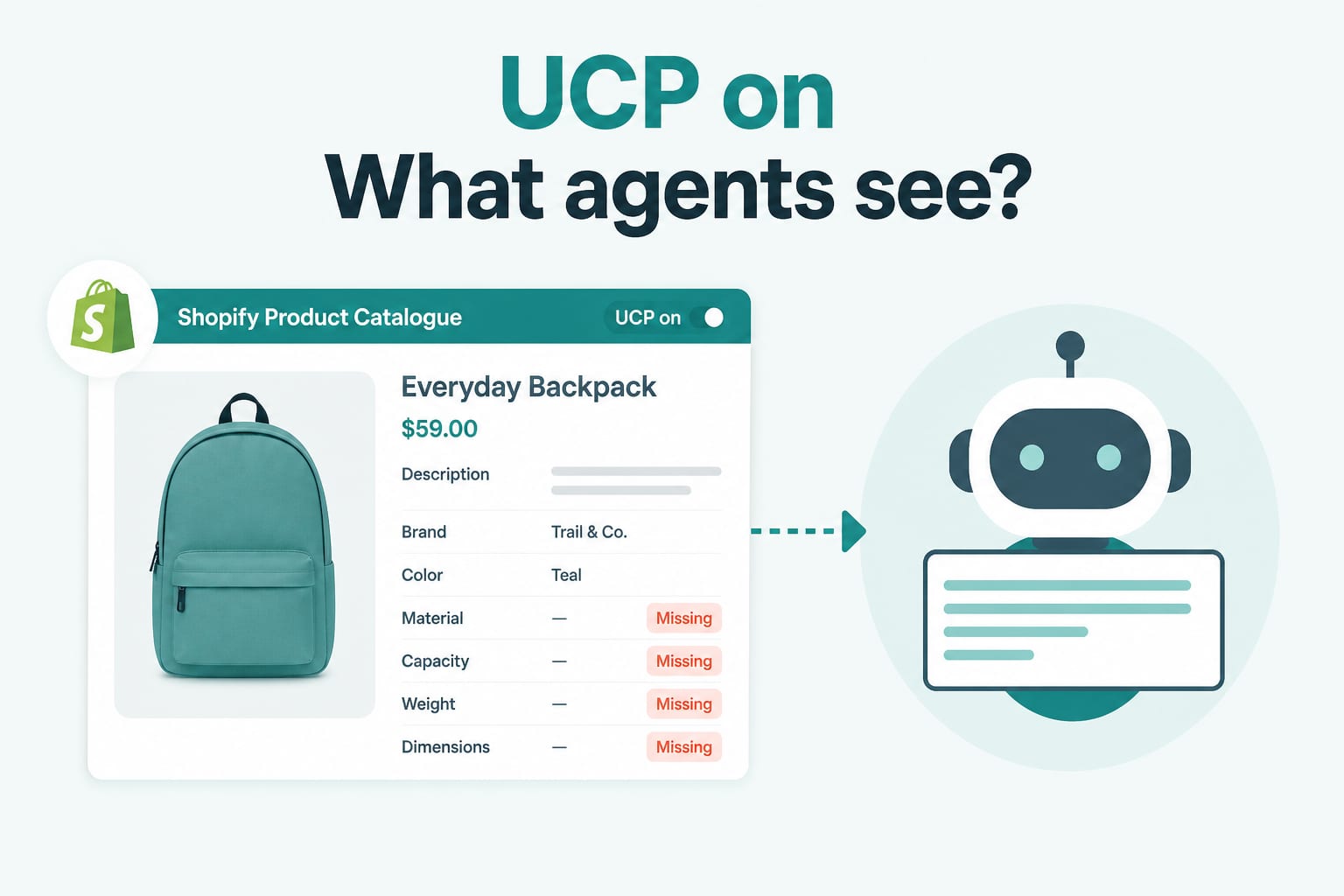
Technical SEOJul 21, 2026
UCP Is On by Default: Is Your Shopify Catalogue Ready for AI Agents?
Summer '26 turned on the Universal Commerce Protocol for every Shopify store and added an Agentic section to the admin. Your products are already exposed to AI shopping agents. Here is how to audit what they actually see.
7 min read
Technical SEOApr 14, 2026
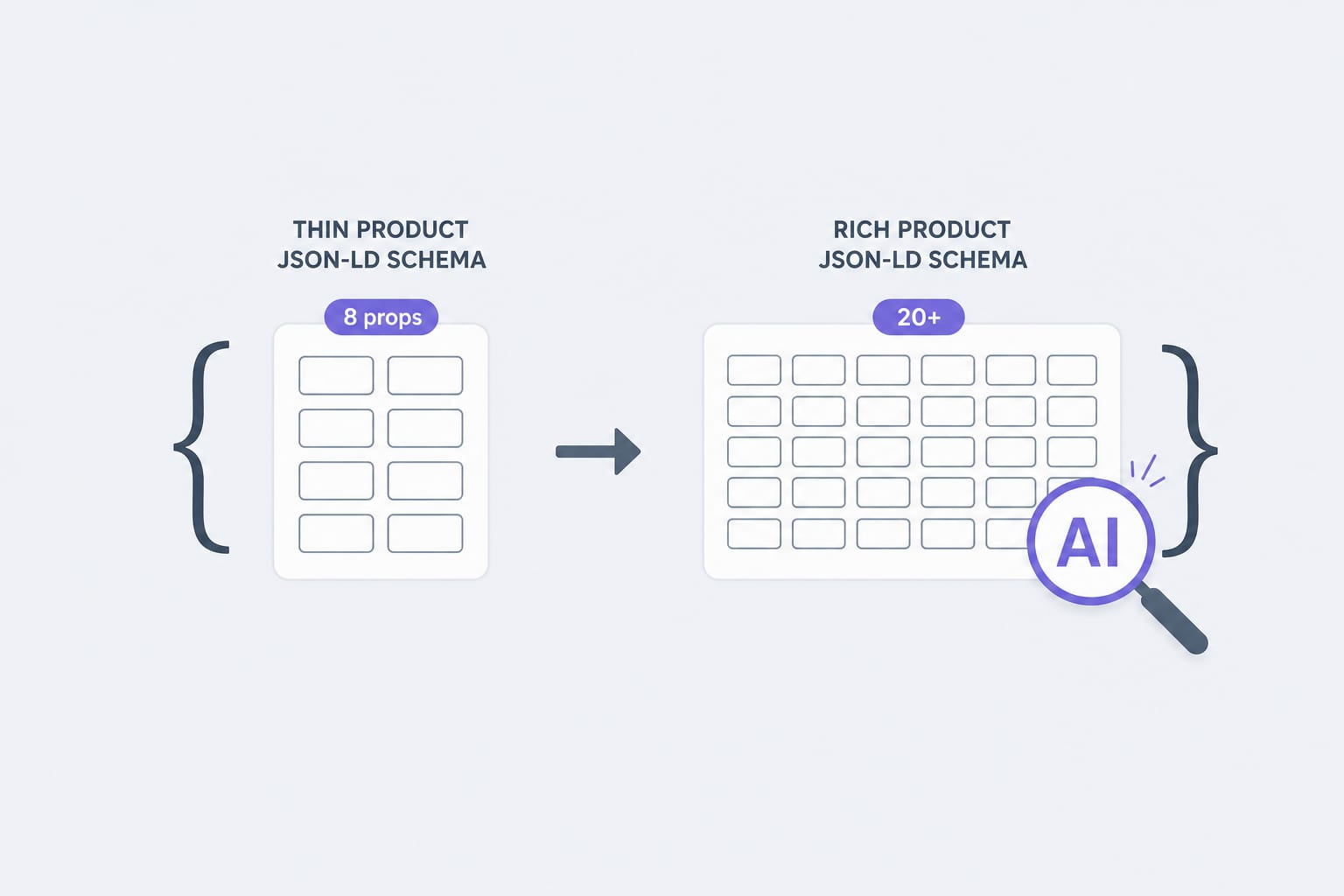
Schema Markup for Shopify in 2026: The JSON-LD Properties AI Agents Actually Read
Traditional Product schema uses 8 to 12 properties. AI agents lean on 20 or more. Here is the property list, the validation rules, and the implementation pattern we use for Shopify stores in 2026.
12 min read
Technical SEOFeb 3, 2026
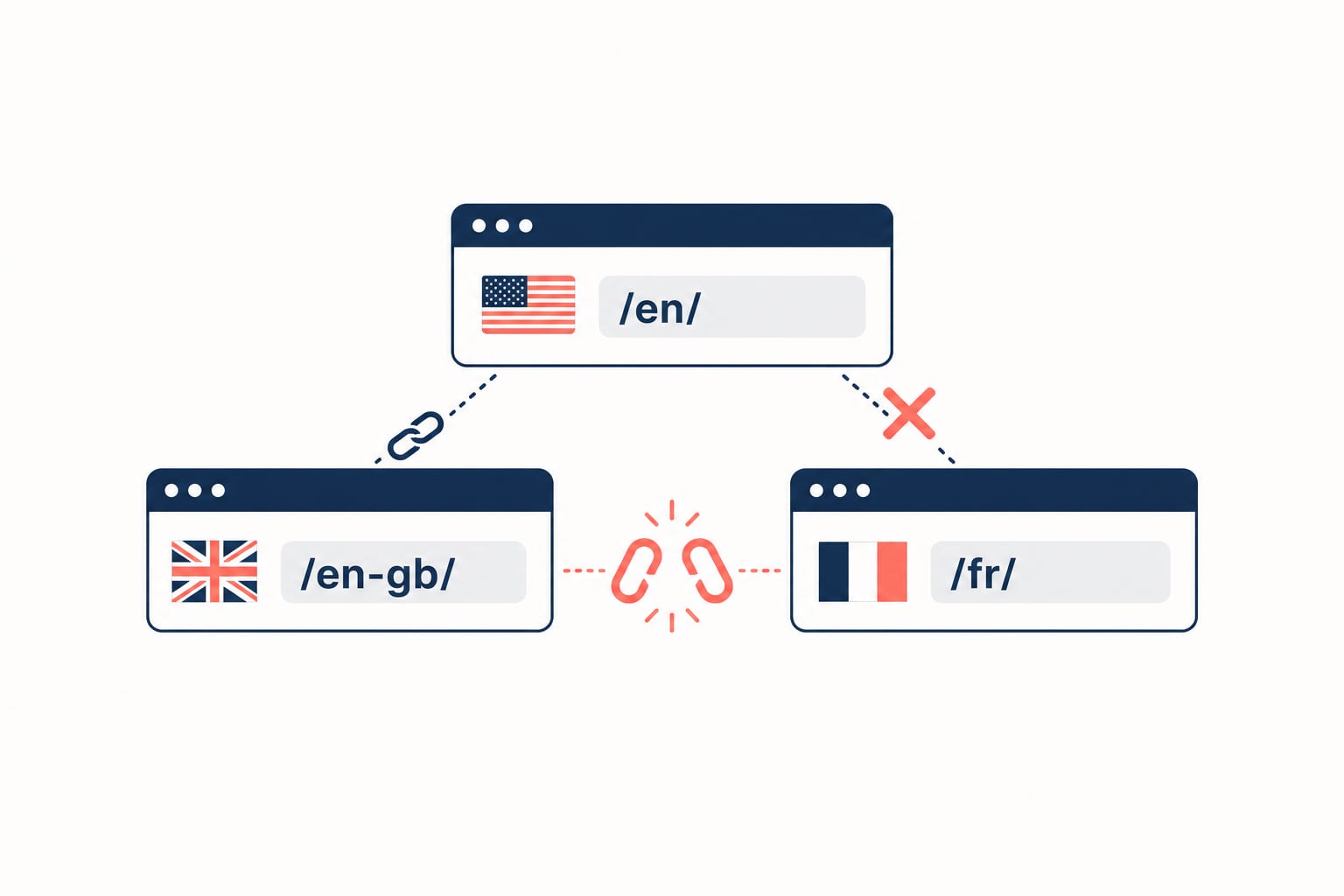
Hreflang on Shopify: The International SEO Setup That Actually Works
A senior engineer's hreflang setup guide for Shopify in 2026. When to use Markets vs multi-store, how canonicals interact with hreflang, the validation playbook, and the migration trap nobody warns you about.
11 min read