Hydrogen v2026.4.0: The Two Breaking Changes You Cannot Ignore Before June 30
Shopify's April Hydrogen release made the Storefront API proxy mandatory and moved consent tracking server-side. Here is what breaks, what to migrate, and how to ship the fix before the June 30, 2026 deadline.
10 min read
If you run a Hydrogen storefront in production, the clock is ticking. Shopify shipped Hydrogen v2026.4.0 on April 9, 2026, and bundled into it are two breaking changes that quietly rewrite how your storefront handles API traffic and customer consent. One of them, the consent migration, has a hard cutoff of June 30, 2026.
Most teams will skim the changelog, see "minor API bump," and move on. That is a mistake. If your build relied on disabling proxyStandardRoutes, or if you ever wrote custom code against the legacy _tracking_consent cookie, your storefront is either already throwing errors or building on infrastructure Shopify is actively removing.
Here is exactly what changed, what breaks, who is at risk, and what you need to do about it.
A quick note on Hydrogen versioning in 2026
Before we dig in, one clarification we hear constantly from clients: there is no "Hydrogen 3.0". Shopify moved Hydrogen to calendar versioning in 2024. Releases now follow the pattern YEAR.QUARTER.PATCH, aligned to Storefront API versions. The current cadence is one headline release per quarter, with patches in between.
That means:
| Release | Tag | Notes |
|---|---|---|
| January 2026 | v2026.1.0 | Quarterly API bump (2026-01), no Hydrogen-specific features |
| April 2026 | v2026.4.0 | API 2026-04, two breaking changes (this post) |
| Winter '26 Edition | December 2025 | Added Storefront MCP support for AI agents |
If you are still on v2025.x or earlier, you are not just behind on features. You are building on a Storefront API version that will be deprecated, and on consent tracking infrastructure Shopify is sunsetting in June. (If you are still weighing the stack itself, our Hydrogen vs Next.js comparison breaks down when each one wins.)
Breaking change #1: the Storefront API proxy is now mandatory
What changed
In v2026.1 and earlier, the createRequestHandler function accepted a proxyStandardRoutes option. It defaulted to true, but you could disable it. If your load context was missing a storefront instance, Hydrogen would log a console warning and quietly skip the proxy.
In v2026.4.0, that option is gone. The proxy is always on, and a missing storefront instance now throws a hard error at request time.
// Before (v2026.1)
createRequestHandler({
  build,
  getLoadContext,
  proxyStandardRoutes: true, // optional, defaulted to true
});
// Missing storefront in context => console warning, proxy skipped silently

// After (v2026.4)
createRequestHandler({
  build,
  getLoadContext,
  // proxyStandardRoutes is gone, proxy is always enabled
});
// Missing storefront in context => throws Error, requests fail
Why Shopify did this
Two reasons, both legitimate, neither optional anymore.
First, token security. Direct browser-to-Storefront-API calls were always a leak risk. Your Storefront access token ends up in the client bundle. With the proxy mandatory, that token stays server-side where it belongs.
Second, CORS and bot abuse. As Shopify pivots to agent commerce (we will write more on this), they need a single, controlled ingress point for every storefront request. The proxy is that point.
Who breaks
You are exposed if any of the following are true:
- You explicitly set
proxyStandardRoutes: falsesomewhere in your server entry. - You wrote a custom
getLoadContextthat does not always return astorefrontinstance (for example, conditional logic for healthcheck routes or admin paths). - You hand-rolled a fetch wrapper that calls
shopify-storefront-api-XX.myshopify.comdirectly from the browser. - You have older Hydrogen scaffolding that predates
createHydrogenContext()and built the context manually.
If you used npx shopify hydrogen init recently and never touched the server entry, you are probably fine. createHydrogenContext() already returns a storefront instance on every request, and the proxy was already enabled by default.
The fix
The migration is straightforward but requires a real test pass:
- Audit your server entry. Search your codebase for
proxyStandardRoutesandcreateRequestHandler. Remove any explicitproxyStandardRoutesargument. - Verify your load context. If you use
createHydrogenContext(), you are done. If you build context manually, confirmstorefrontis always present, including on error routes, robots.txt handlers, and any custom middleware. - Audit client fetches. Grep for any direct calls to
myshopify.com/api/. If found, route them through the storefront proxy viastorefront.query()instead. - Test under load. Spin up a preview environment and hit every route type: PDP, PLP, cart mutations, customer account, and the routes your team forgets exist.
Breaking change #2: consent tracking moved server-side
What changed
Hydrogen now sets window.Shopify.customerPrivacy.backendConsentEnabled = true before the Customer Privacy API script loads. This flag tells Shopify's consent library to use server-set cookies via the Storefront API proxy instead of the legacy _tracking_consent JavaScript cookie.
The flag is installed through a property interceptor on window.Shopify that survives the CDN's window.Shopify = {} reset cycle, so it is readable before the full API loads.
If you are using Hydrogen's <ShopifyCustomerPrivacy /> component, or the <Analytics.Provider /> wrapper that includes it, this happens automatically. No new config is required.
The deadline that matters
⏳
The legacy _tracking_consent cookie path is being deprecated on June 30, 2026. After that date, consent state stored only in the old cookie will not be honored. Storefronts that have not migrated will silently lose consent context, which has direct GDPR and ePrivacy implications in the EU and UK.
Who breaks
Less obvious than the proxy change, but more dangerous in practice:
- You read or wrote
_tracking_consentdirectly in custom analytics code. - You forked or replaced Hydrogen's
<ShopifyCustomerPrivacy />component with a custom CMP integration (OneTrust, Didomi, Cookiebot) that bypasses the new server-set flow. - You ship analytics events (GA4, Meta CAPI, server-side tagging) gated on consent state read from the legacy cookie.
- You are on Hydrogen
v2025.xor older and have no migration plan.
The fix
Upgrade to v2026.4.0 or later and make sure you are using Hydrogen's first-party analytics primitives. If you run a third-party CMP, work with the vendor to read consent from the new server-set cookie path rather than the deprecated JS cookie.
For teams running EU and UK storefronts, this is not optional housekeeping. It is your compliance posture. The shift to server-side consent is also good news long-term: it survives ad blockers, browser privacy modes, and ITP, all of which were slowly eroding the reliability of client-side consent state. If your stack already leans into server-side tracking on Shopify, the new consent flow slots in cleanly.
Other changes worth knowing about
The April release shipped a few smaller items that bite if you are unaware:
- 128KB limit on JSON metafield writes. If you stash large product configurators or PIM exports in JSON metafields, writes above 128KB now reject. Audit your largest payloads and consider splitting or moving to file storage.
- New cart error code
MERCHANDISE_LINE_TRANSFORMERS_RUN_ERROR. If you use Shopify Functions cart line transformers, handle this code in your cart error UI so the user sees something better than a silent failure. - React Router peer dependency range fix. A previous range mismatch could cause
npm installresolution headaches. Worth a clean install if you have been fighting peer warnings. - Shopify Scripts hard cutoff. This is not in Hydrogen itself, but it is the same June 30, 2026 deadline. Legacy Scripts for discounts, shipping, and payments stop executing. If you have not already, see our Shopify Scripts to Functions migration playbook and start now.
A pragmatic migration plan
If you operate a Hydrogen storefront and you have not touched it since 2025, here is the order we would run it in:
- Lock the room. Branch off
main, freeze unrelated PRs for two days. This is a focused upgrade, not a sprint to bundle features into. - Run
npx shopify hydrogen upgrade. Let the CLI do the dependency math. Read every prompt. - Fix compile errors first. Remove
proxyStandardRoutes, update React Router peer deps, regenerate types. - Run the full test suite. Especially cart and checkout flows. The proxy change is the most likely place for a regression.
- Manual QA on a preview deploy. Test consent banner flow with cookies cleared, in incognito, and on Safari with ITP. Consent is where silent breakage hides.
- Audit your JSON metafield writes. Grep for anything that builds a JSON payload going to a metafield and confirm none exceed 128KB.
- Ship to staging, soak for 48 hours. Watch the error tracker for any uptick in 500s or analytics drops.
- Production deploy, monitor for 72 hours. Have a rollback path ready.
For most stores with a clean Hydrogen codebase, this is a one to three day exercise. For stores carrying technical debt, custom analytics, or third-party CMPs, plan a full week.
When to ask for help
You should bring in a specialist if any of these apply:
- Your storefront is on Hydrogen
v2024.xor earlier and has not been upgraded incrementally. Skipping multiple API versions stacks breaking changes on top of each other. - You run a custom CMP and need to wire it to the new server-set consent cookie path.
- You have heavy use of Shopify Scripts that also need to migrate to Functions before June 30.
- You have no clear test coverage on cart and checkout flows.
- You are unsure whether your storefront is even on Hydrogen, or running a hybrid setup with custom proxies.
At Sentinu, we work on exactly this kind of Hydrogen and headless Shopify infrastructure work day to day. If you want a second pair of eyes on your v2026.4.0 migration, or a full audit of where your headless build is exposed, book a strategy call or read more about our headless Shopify practice.
FAQ
Is v2026.4.0 mandatory, or can we stay on v2026.1.0?
You can technically stay on v2026.1.0 for a while, but the June 30, 2026 consent deprecation is enforced at the Shopify platform level, not at the Hydrogen package level. Even if you do not upgrade, the underlying _tracking_consent cookie behavior will change. Upgrading is the cleanest way to get the new server-set consent flow handled for you.
What happens if we miss the June 30 deadline?
The _tracking_consent cookie path stops being honored. Your storefront will continue to load, but consent state stored only in the legacy cookie will not be respected by Shopify's analytics, ad tracking, or Customer Privacy API. For EU and UK merchants, this becomes a GDPR and ePrivacy issue immediately. For everyone else, your conversion attribution data quality drops.
Does this affect Hydrogen storefronts not hosted on Oxygen?
Yes. The breaking changes are in the @shopify/hydrogen package itself, not in Oxygen. If you self-host on Vercel, Netlify, Cloudflare, or your own infrastructure, you still need to upgrade and verify your custom load context returns a storefront instance.
We use a third-party CMP like OneTrust or Didomi. Are we affected?
Potentially yes. If your CMP integration reads consent state from _tracking_consent directly, or writes back to it, that path is deprecated. Work with your CMP vendor to read from the new server-set cookie path. Some CMPs already shipped updates, others have not.
Can we test the proxy change without breaking production?
Yes. Deploy v2026.4.0 to a preview environment, run the proxy check by hitting your storefront routes with the network tab open, and confirm all Storefront API traffic goes through your own domain rather than directly to myshopify.com. If you see any direct calls, you have a fetch wrapper that needs migrating before you ship to production.
Related Topics
Related posts
View all articles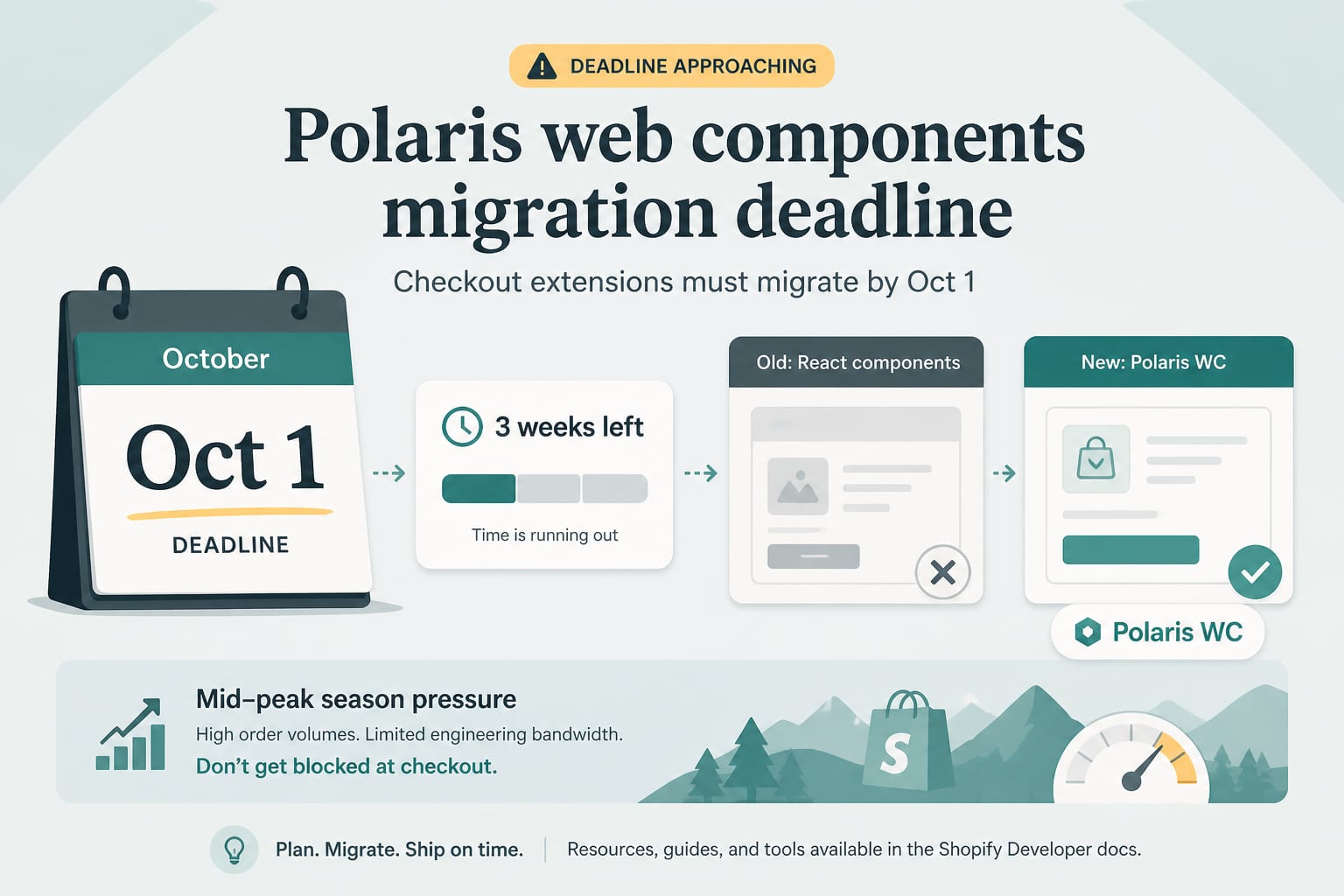
Shopify DevelopmentSep 8, 2026
1 October Is Real: The Polaris Web Components Deadline for Checkout Extensions
From 1 October, Shopify blocks updates to any app that still has a checkout or customer account extension on API version 2025-07 or earlier. Three weeks of runway, a mid-peak-season deadline, and a migration most teams have not started.
8 min read
Shopify DevelopmentSep 1, 2026
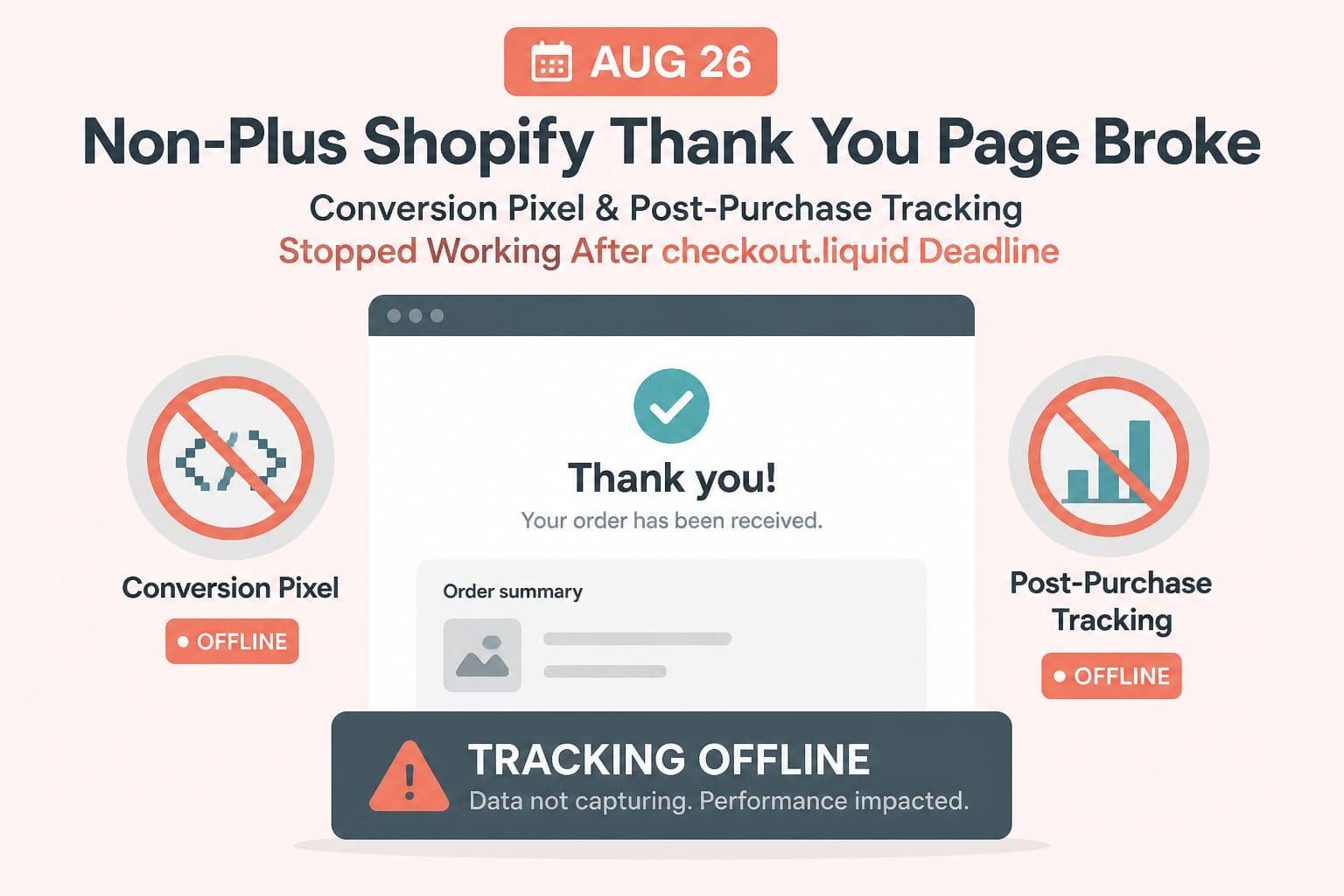
The Other Checkout Deadline Just Passed: What Broke on Non-Plus Stores on 26 August
The checkout.liquid thank you and order status migration deadline landed on 26 August for non-Plus stores. If your conversion pixels, post-purchase upsells or affiliate tracking still lived there, they stopped working. Here is how to find out.
7 min read
Shopify DevelopmentJul 7, 2026
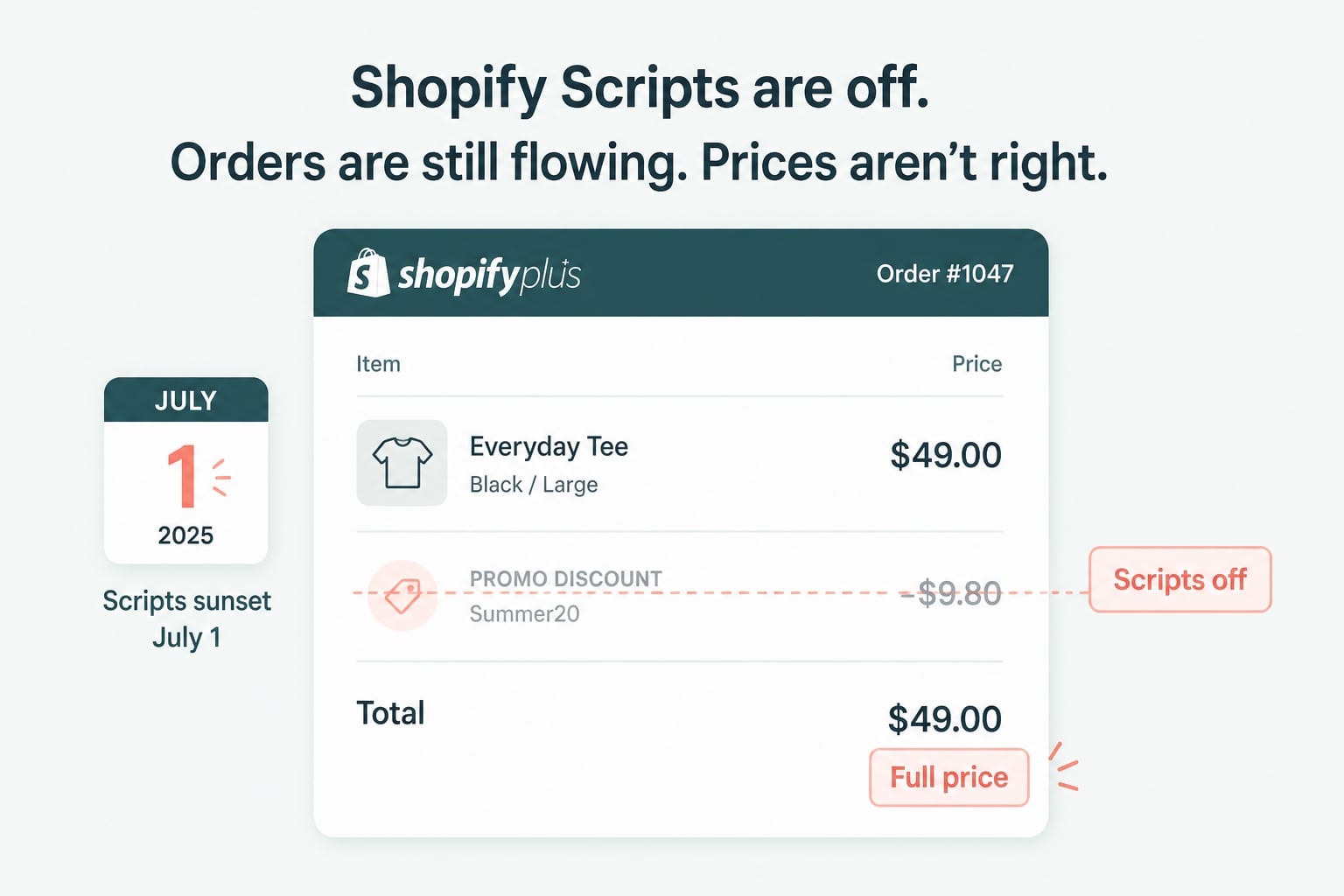
Shopify Scripts Went Dark on July 1: The Post-Sunset Audit
Legacy Scripts stopped executing on June 30. Here is how to find the discount, shipping and payment logic that quietly disappeared from your store, and what to rebuild first.
7 min read