August 2026 Ranking Volatility: Core Update, or Something Else Entirely?
Trackers spiked on 1 August and the forums called it a core update. Google has confirmed nothing. Here is a diagnostic order of operations for separating a real ranking change from an ad server outage and a broken analytics pipeline.
7 min read
Third-party rank trackers spiked hard on 1 August and stayed hot through the 5th and 6th. Forums filled with reports of overnight drops. By the end of the first week, most SEO newsletters had named it the August core update.
Google has confirmed no such thing. As of this week the Search Status Dashboard shows no ranking, indexing, crawling or serving incident for the period, and the last confirmed ranking change remains the June 2026 spam update, which ran from 24 to 26 June.
That gap between what happened and what is being claimed matters, because the correct response is entirely different depending on which it is. Rewriting content because of what turned out to be a reporting outage is one of the more expensive mistakes available in this job.
What we can actually say
Three things are established.
The volatility is real. Multiple independent trackers moved together starting 1 August. That is measurable and not in dispute.
Nothing is confirmed. Google has named no core update for July or August 2026. The company has also indicated that smaller core adjustments now run continuously in the background without announcements, which means the absence of a named update does not mean the absence of ranking change. It also means you cannot date your drop to a rollout window.
At least three separate disruptions overlapped in the same week. Search volatility, a Google Ad Manager disruption on 4 August, and a run of GA4 real-time reporting complaints. Publishers reported contradictory experiences, with disagreement over start dates, affected surfaces and even the direction of the change. That is not the signature of one broad ranking update.
🧭
When several things break in the same week, the first job is attribution, not remediation. A site that lost revenue to an ad serving fault and then rewrote forty articles has spent a month solving the wrong problem.
The diagnostic order of operations
Work through these in sequence. Do not skip to step four.
- Separate impressions from clicks in Search Console. Impressions down and clicks down together points to a ranking or indexing change. Impressions stable with clicks down points to a click-through problem, which is often a SERP feature change or an AI Overview appearing above you, not a demotion.
- Check whether your analytics agree with Search Console. If GA4 shows a collapse that Search Console does not, your problem is measurement. Given the GA4 reporting complaints in the same window, this is a live possibility and it is the cheapest to rule out.
- Check revenue independently of both. Pull orders from your commerce backend, not from an analytics property. If orders held while sessions fell, you have a tracking fault. If orders fell with sessions, the traffic loss is real.
- Check whether the loss is ad-adjacent. For publishers and content-heavy commerce sites, the 4 August Ad Manager disruption affected revenue without affecting traffic. Those are different symptoms with different fixes.
- Segment by query type before by page. Compare informational, navigational and commercial queries separately. A broad quality reassessment tends to hit informational content hardest. A spam update aftershock behaves differently. A SERP layout change hits specific query classes.
- Only then look at pages. By this point you know whether you are investigating a ranking change at all, and you know which segment to investigate.
Step one is fast if you pull it rather than clicking through the interface:
// Compare the 14 days before and after 1 August 2026 in Search Console.
// Impressions and clicks moving together means ranking. Diverging means CTR or SERP layout.
async function comparePeriods(client, siteUrl) {
  const request = (startDate, endDate) => ({
    siteUrl,
    requestBody: {
      startDate,
      endDate,
      dimensions: ["query"],
      rowLimit: 25000
    }
  });

  const before = await client.searchanalytics.query(request("2026-07-18", "2026-07-31"));
  const after = await client.searchanalytics.query(request("2026-08-01", "2026-08-14"));

  const totals = (rows = []) =>
    rows.reduce(
      (acc, r) => ({
        clicks: acc.clicks + r.clicks,
        impressions: acc.impressions + r.impressions
      }),
      { clicks: 0, impressions: 0 }
    );

  const b = totals(before.data.rows);
  const a = totals(after.data.rows);

  return {
    clickChange: (a.clicks - b.clicks) / b.clicks,
    impressionChange: (a.impressions - b.impressions) / b.impressions,
    ctrBefore: b.clicks / b.impressions,
    ctrAfter: a.clicks / a.impressions
  };
}
If impressionChange is roughly flat while clickChange is sharply negative, stop looking for a core update. You have a click-through problem, and in August 2026 the most likely cause is a change in what sits above your result rather than a change in where your result sits.
📉
A useful threshold from experience: movements under ten percent are normal fluctuation and not worth investigating. An impressions drop of thirty percent or more, or an average position falling by ten places or more, is a real signal.
If it turns out to be real
Suppose you have ruled out measurement and ad serving, and traffic genuinely fell. Two constraints shape what to do next.
The first is that Google's last confirmed action was a spam update in June. Spam updates and core updates call for different responses. Spam update impact points at link profile, content generation practices, or site reputation issues. Core update impact points at relative quality assessment against competitors who did not move.
The second is that continuous unannounced adjustments mean there may be no single date to anchor on. If your drop started on 28 July rather than 1 August, that is worth taking seriously as evidence that you are not looking at whatever happened to everyone else on the 1st.
The recovery work is unglamorous and mostly consists of things that were always true. Pages that lost ground usually have thin evidence, unclear intent match, or duplicated coverage of a topic across several URLs that should be one. For commerce sites specifically, index bloat from faceted navigation and near-duplicate collection pages remains the most common structural cause we find in audits.
What not to do
Three responses that reliably make things worse:
- Deleting the page that dropped hardest. Usually it is the page with the most competition, not the worst page. Deletion removes the asset and the diagnostic signal at once.
- Publishing five new articles to signal freshness. Volume was not the problem and adding more of it does not help.
- Acting within the first week. Volatility during and after a rollout is not a final state. Rankings stabilise over weeks, and decisions made on day three are made on incomplete data.
The productive version of urgency is to spend the first two weeks on measurement and diagnosis, which is exactly the work that will still be valid whatever Google does or does not confirm later.
🔬
We run technical SEO audits that start with attribution rather than recommendations, covering Search Console analysis, index bloat, crawl efficiency and structured data. See our technical SEO audit service.
Frequently asked questions
Was there a Google core update in August 2026?
Google has not confirmed one. Trackers show real volatility from 1 August, and Google has said smaller core adjustments now run continuously without announcement, so an unconfirmed change is possible. It is not the same as a named broad core update.
How do I tell a ranking drop from an analytics problem?
Compare Search Console against your analytics property, then compare both against orders pulled directly from your commerce backend. Three sources disagreeing usually means the fault is in measurement.
My traffic fell on 28 July, not 1 August. Is that related?
Possibly not. A different start date is evidence that you are looking at a different cause, and it is worth investigating on its own terms rather than folding it into the general August story.
How long before I should expect recovery?
Rankings typically stabilise over several weeks after a rollout. Meaningful improvement following genuine content and structural work usually needs a subsequent reassessment, which can take a further one to three months.
Should I disavow links after a spam update?
Rarely, and not as a first response. Disavowal is a blunt instrument that frequently causes harm when applied speculatively.
Related Topics
Related posts
View all articles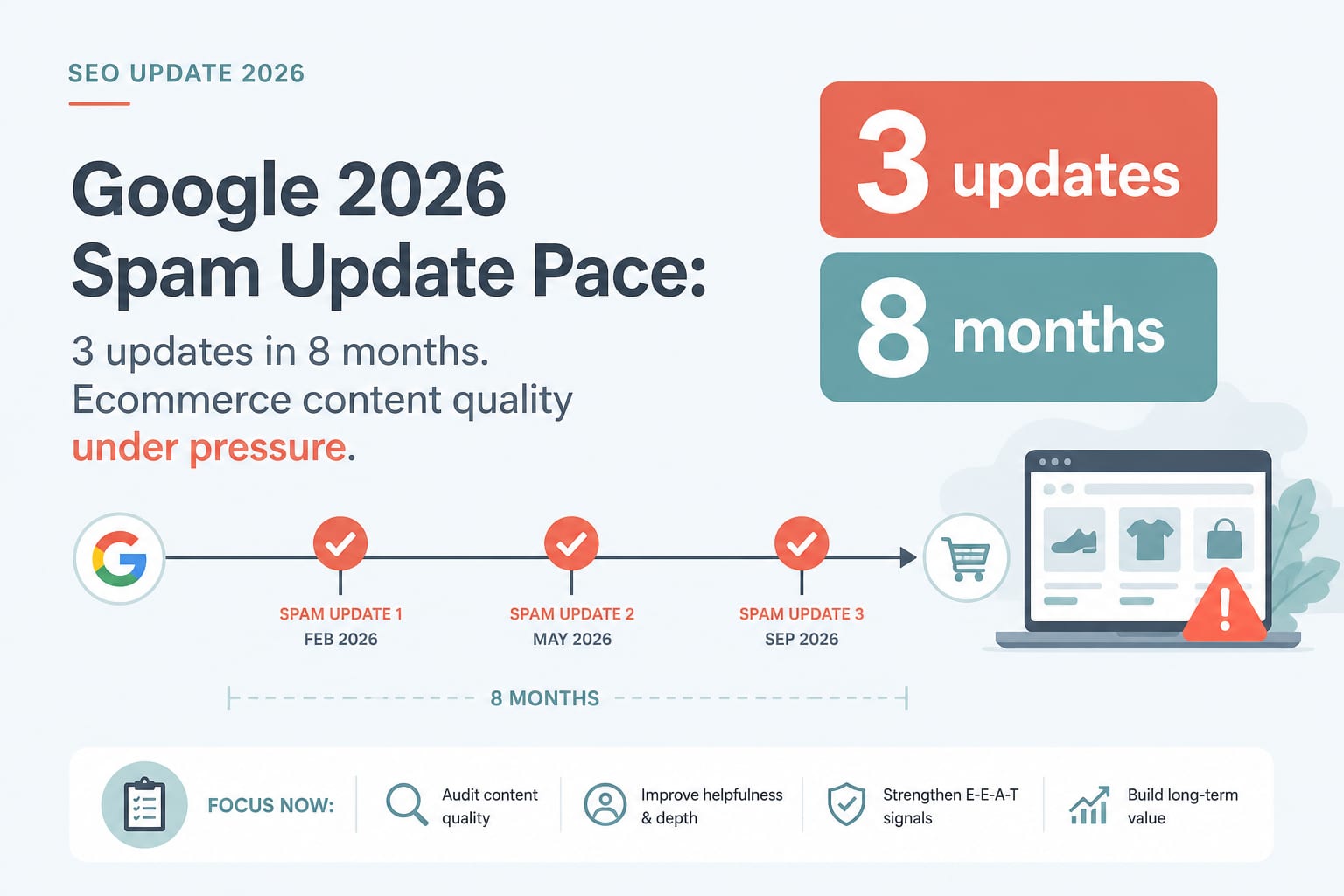
Technical SEOSep 22, 2026
Three Spam Updates in Eight Months: Google's 2026 Enforcement Pace and What It Means for Ecommerce Content
The August 2026 spam update rolled out in under three days, the third this year. Faster rollouts and continuous background adjustments change how you diagnose a drop and how you should be producing content.
7 min read
Technical SEOApr 30, 2026
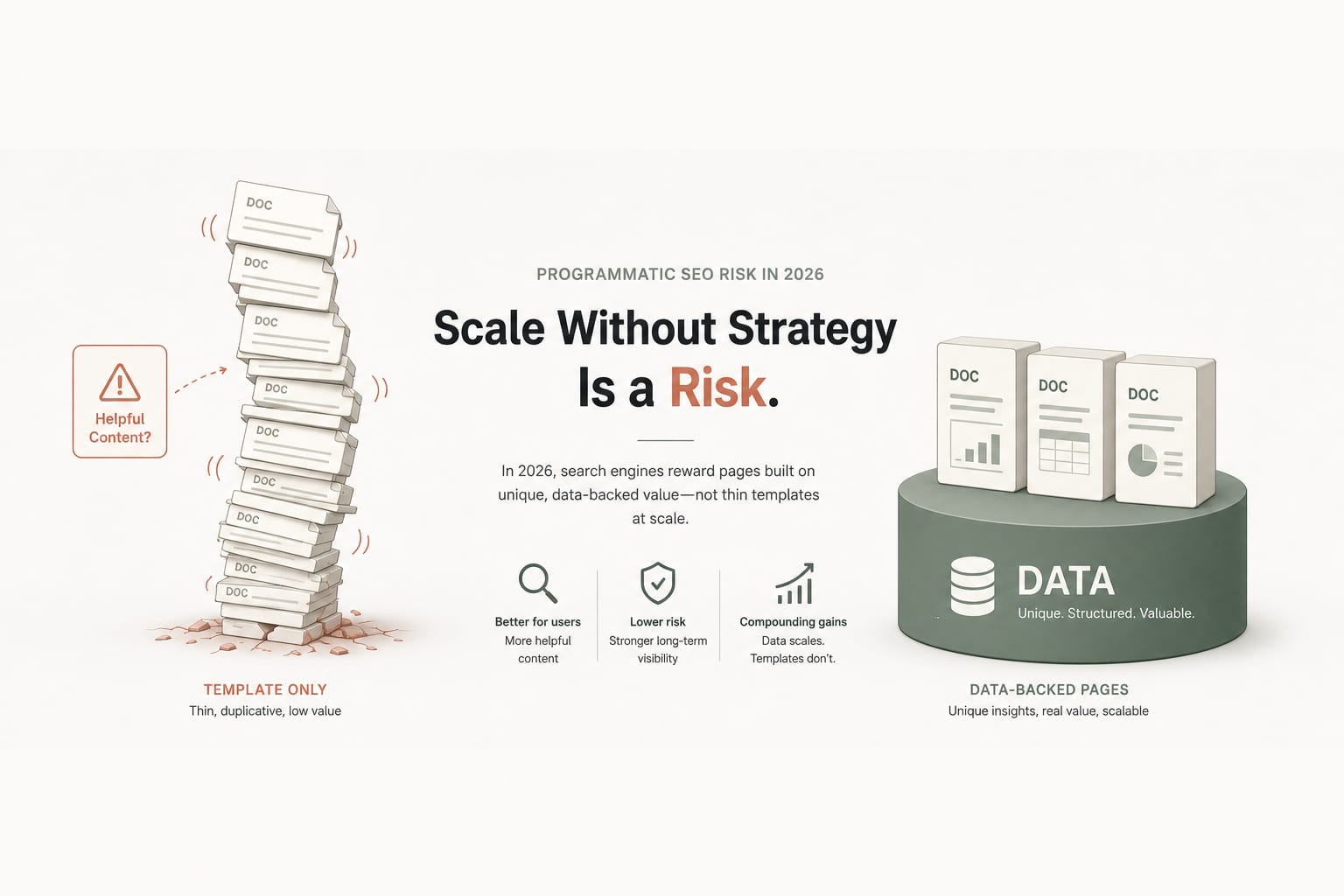
Programmatic SEO in 2026: When It Still Works, When Google Penalizes It, and How to Tell the Difference
Programmatic SEO is not dead. It is just no longer easy. Here is the framework we use in 2026 to decide whether a programmatic SEO project will compound traffic or get nuked by the Helpful Content system in six months.
14 min read
Technical SEOApr 14, 2026
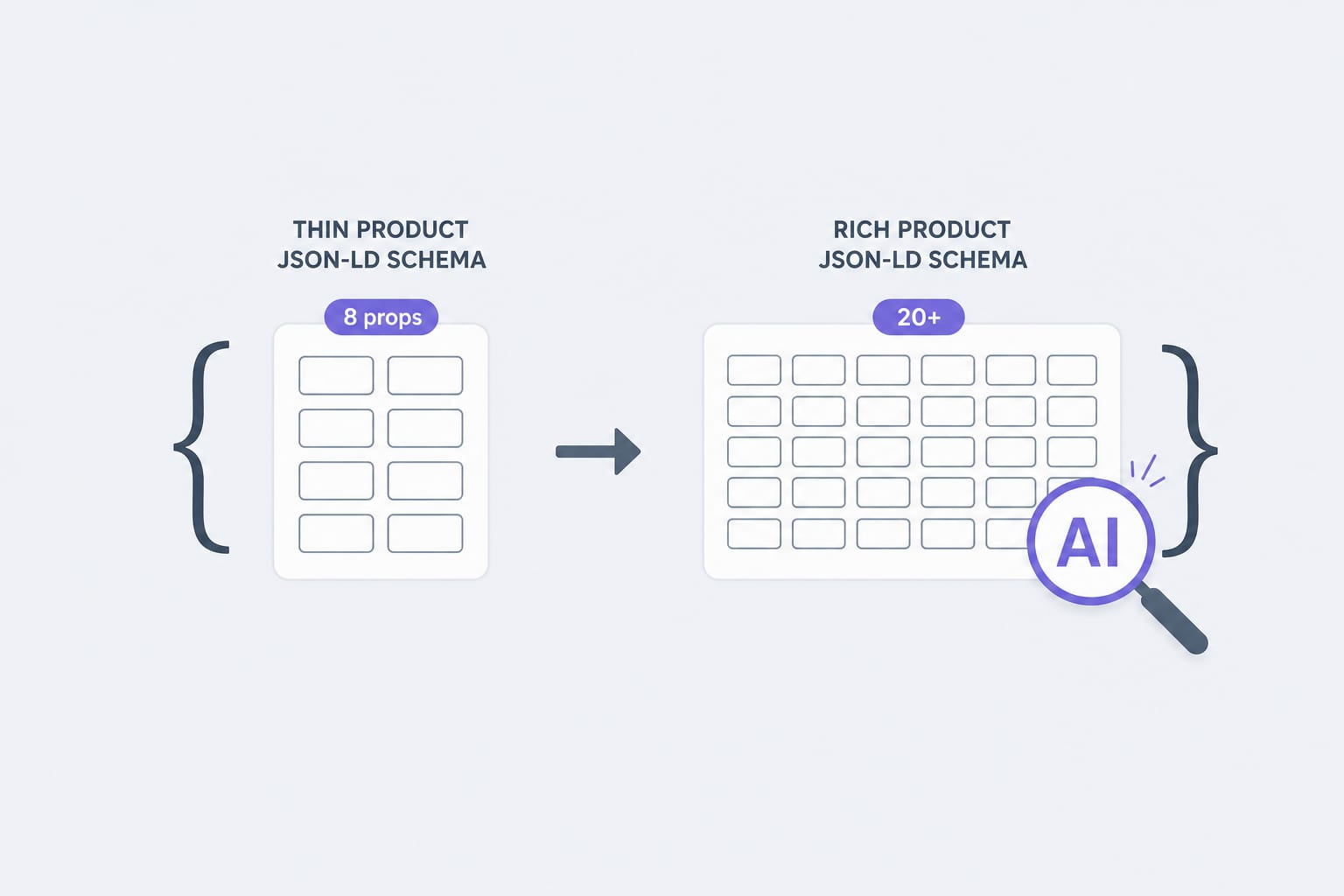
Schema Markup for Shopify in 2026: The JSON-LD Properties AI Agents Actually Read
Traditional Product schema uses 8 to 12 properties. AI agents lean on 20 or more. Here is the property list, the validation rules, and the implementation pattern we use for Shopify stores in 2026.
12 min read